Arenyze
 Rainbow Six
 Arknights: Endfield
 THE FINALS
 Delta Force
A practical guide to the Arenyze public API
One key, one host and three games. How to get a key, make your first request, identify players in Rainbow Six Siege, THE FINALS and Arknights: Endfield, stay inside the limits and let webhooks do the polling for you.
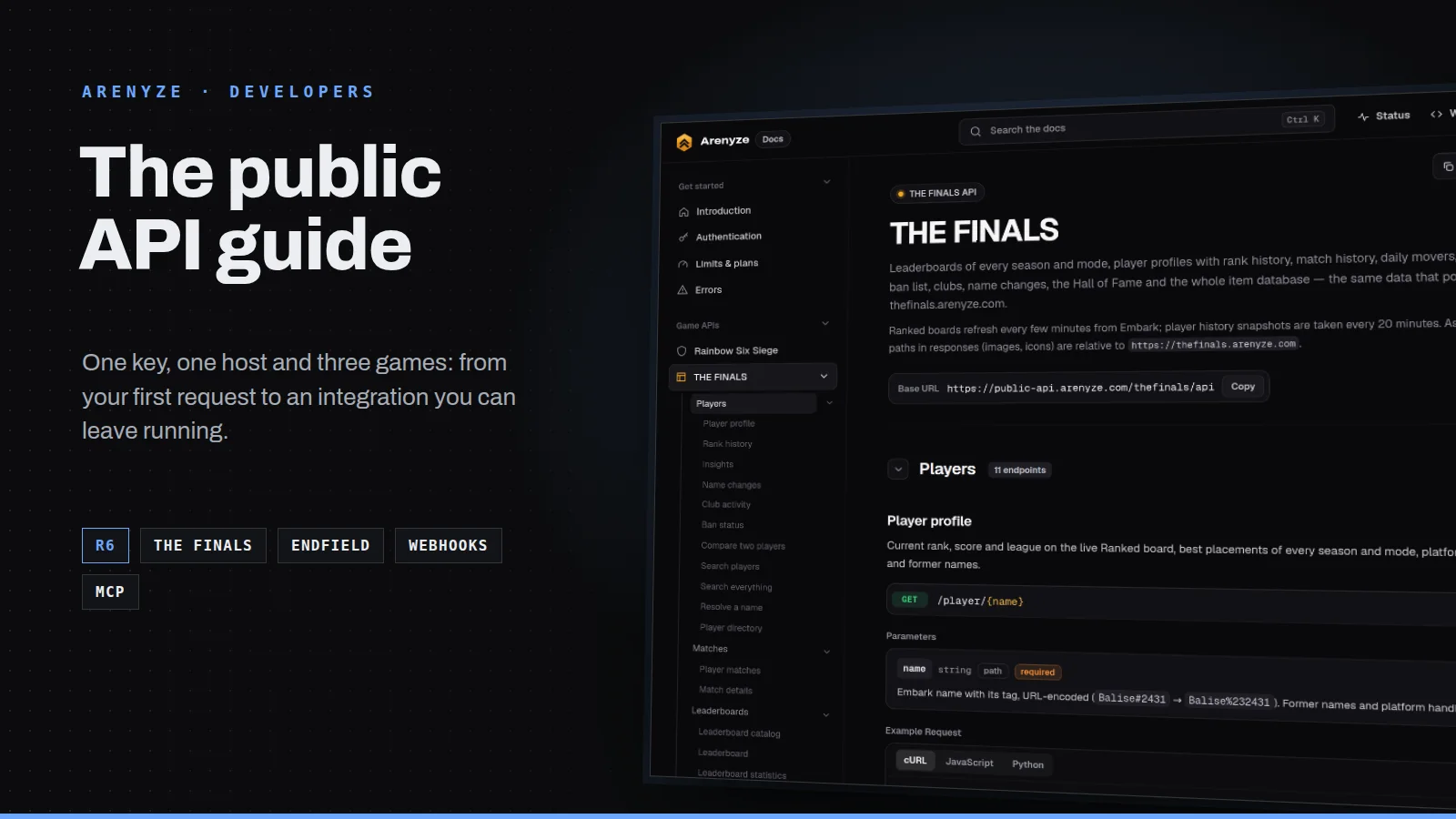
In this article10 sections
Every number you see on the Arenyze trackers — a Rainbow Six Siege rank, a THE FINALS leaderboard position, an Arknights: Endfield operator build — is also available to developers through one public API. This guide covers the whole path from an empty project to an integration you can leave running: getting a key, making the first call, identifying players in each game, staying inside the limits and letting Arenyze push changes to you instead of polling.
The guide does not replace the reference documentation. It explains how the pieces fit together, the decisions to make early, and the mistakes we most often see in support requests.
- One host:
https://public-api.arenyze.com/<game>/api, where the game isr6,thefinalsorendfield. - One key for the three games, sent in the
api-keyheader. It is created in the Workbench. - Read-only REST: every endpoint is a
GETthat returns JSON. - Free to start: 2,000 calls a month on the Free plan, shared by the three games.
- Beyond requests: signed webhooks, no-code Flows and a hosted MCP server for AI assistants.
What is in the API
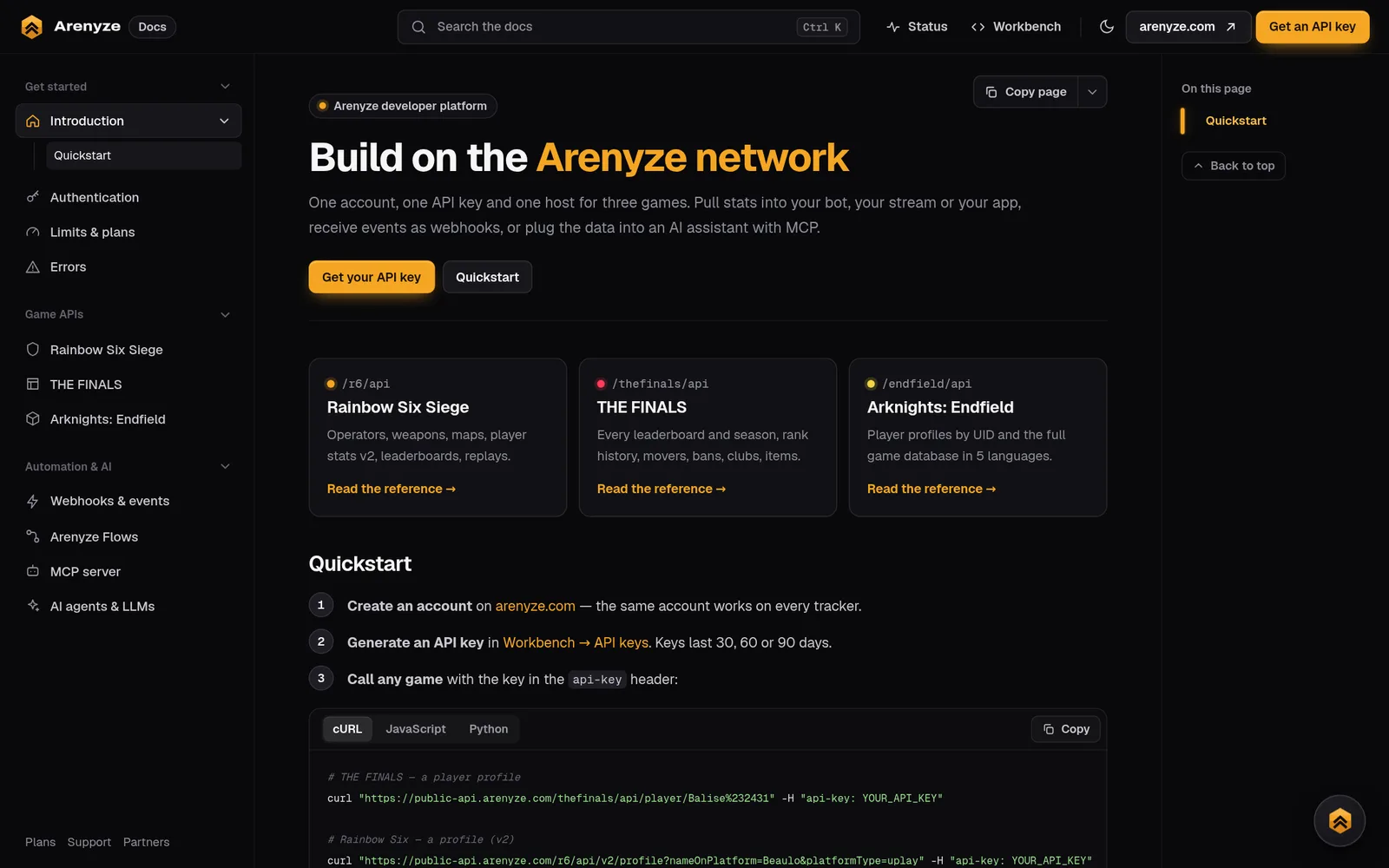
The API exposes the same data that powers the trackers, so anything a player can look up on the website can also be read by your code. The three games share the host, the key, the error format and the quota. Each game keeps the shape that suits its data.
| Game | Base path | Endpoints | Players are found by |
|---|---|---|---|
| Rainbow Six Siege | /r6/api | 17 | Name + platform |
| THE FINALS | /thefinals/api | 40 | Embark name with tag |
| Arknights: Endfield | /endfield/api | 15 | Numeric UID |
- Rainbow Six Siege: operators, weapons, maps, seasons, ranks, skins, charms and attachments. Player profiles and full stats come from the v2 endpoints, along with per-operator stats and the ranked leaderboards.
- THE FINALS has the largest surface:
- players: profiles, rank history, insights, name changes, club activity, ban status and match history;
- the competition: leaderboards for every season and mode, daily movers, clubs, the Hall of Fame and the ban list;
- game data: the item database, loadouts and the live player count.
- Arknights: Endfield: public player profiles by UID, an operator's build for a given player, and the game database (operators, weapons, gear and gear sets, items, AIC factory facilities and recipes).
Get an API key
Keys live in the Arenyze Workbench, the developer workspace that also hosts webhooks, logs and the sandbox.
- Sign in at workbench.arenyze.com with your Arenyze account. The same account works on every tracker; if you do not have one, create one for free.
- Open API keys in production and create a key. Choose how long it lasts: 30, 60 or 90 days. The panel shows the time left, and you get a notification before the key expires.
- Copy the key into your server's environment, for example as
ARENYZE_API_KEY. Never commit it to a repository.
Each account has one active key. Regenerate replaces it immediately and the old key stops working on every game, so rotate it whenever you think it may have leaked.
Keep the key on a serverAnyone who has your key spends your quota. Do not put it in a web page, a browser extension or a mobile app, where it can be read by anyone. Call the API from your backend, cache the answer and serve your own users from the cache.
Your first request
A good first call is the profile of a THE FINALS player. Note how the # in the Embark name is encoded as %23: it is the most common reason for an unexpected 404 in a new integration.
curl "https://public-api.arenyze.com/thefinals/api/player/Balise%232431" \
  -H "api-key: $ARENYZE_API_KEY"
const name = encodeURIComponent("Balise#2431"); // → Balise%232431
const res = await fetch(`https://public-api.arenyze.com/thefinals/api/player/${name}`, {
headers: { "api-key": process.env.ARENYZE_API_KEY },
});
if (!res.ok) throw new Error((await res.json()).error);
const player = await res.json();
console.log(player.displayName, player.formerNames.length, "former names");import os, requests
from urllib.parse import quote
name = quote("Balise#2431", safe="") # → Balise%232431
r = requests.get(
f"https://public-api.arenyze.com/thefinals/api/player/{name}",
headers={"api-key": os.environ["ARENYZE_API_KEY"]},
timeout=20,
)
r.raise_for_status()
player = r.json()The response is plain JSON: the current rank, score and league on the live Ranked board, the best placements of every season and mode, platform handles, the club and former names. If you forget the key, the API answers with a clear error instead of an empty body:
{
  "error": "MISSING_API_KEY",
  "message": "Send your Arenyze API key in the api-key header (or Authorization: Bearer)."
}
THE FINALS and Endfield also accept the key as Authorization: Bearer <key>, which is convenient with HTTP clients that have built-in bearer support. Rainbow Six Siege only reads the api-key header, so use that one everywhere and your code stays the same for the three games.
Identifying players in each game
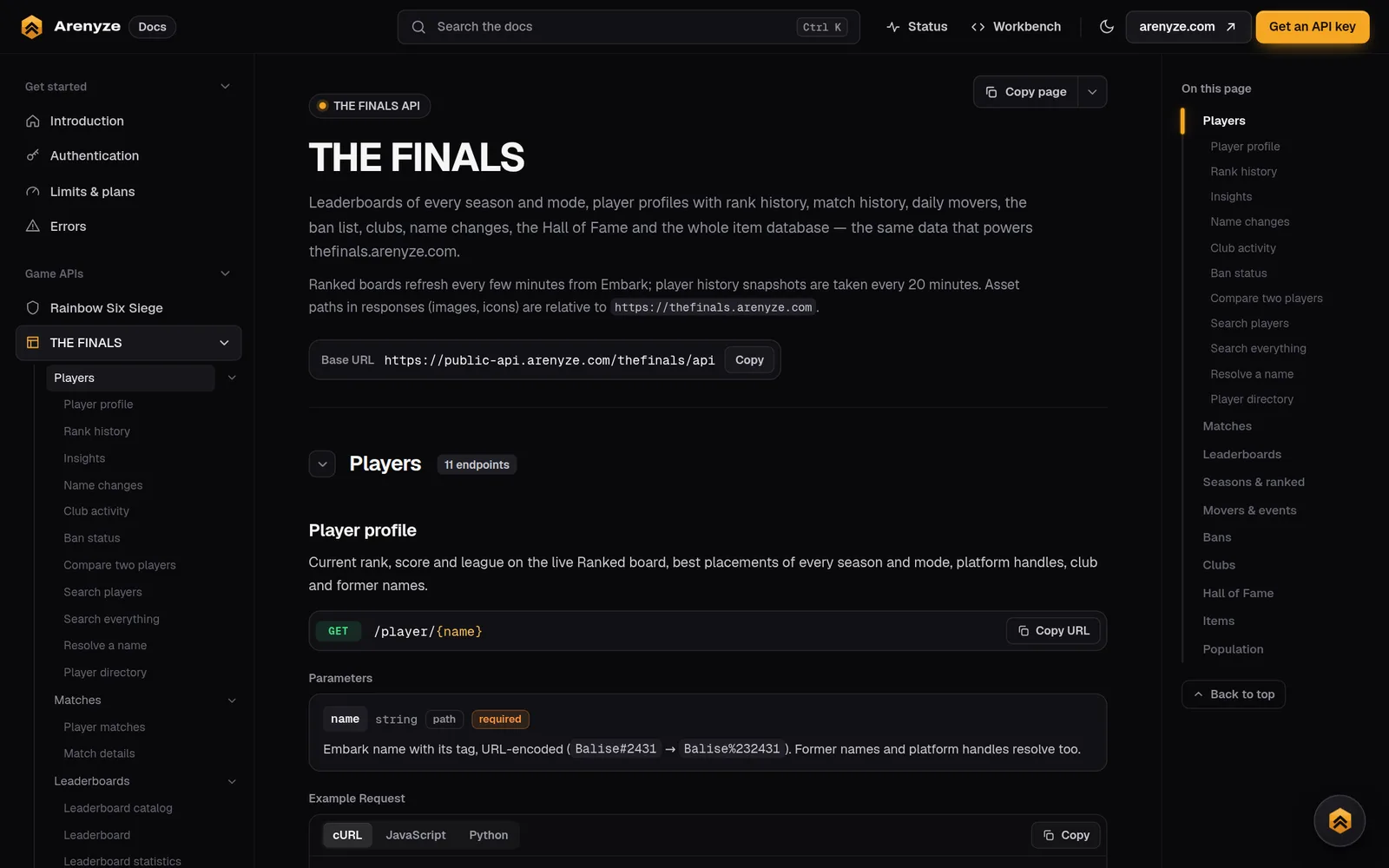
Each game identifies its players differently, and most integration bugs come from this step. Decide early how your users will tell you who they are, and store that identifier rather than a display name.
THE FINALS: the Embark name
Players are identified by their Embark name with its tag, such as Balise#2431, URL-encoded in the path. Former names and platform handles resolve too, so a player who renamed is still found. If your users only type part of a name, call /thefinals/api/search?q= first and let them pick the right result.
Rainbow Six Siege: name and platform
R6 player endpoints need two parameters: nameOnPlatform and platformType, which is uplay for PC, psn for PlayStation or xbl for Xbox. The same name can exist on different platforms, so always store both.
The v2 profile endpoint returns the whole player page in one request: account details, current boards, ban status, season segments and rank-points history. Per-operator statistics are loaded separately from /r6/api/v2/operators, because they are larger and not every page needs them.
Arknights: Endfield: the UID
Endfield profiles are identified by the numeric UID shown on the in-game profile card, as in /endfield/api/players/{uid}. When you only have a name, /endfield/api/players/search?q= finds players that are already known to the tracker. Private profiles and hidden showcases stay private in the API too.
Rainbow Six Siege with the SDK
For Node.js projects that work with Rainbow Six Siege, the official package @arenyze/rainbow-six-siege wraps the R6 API with typed parameters and responses. It is the successor of the r6-data.js package that R6Data users know.
// npm i @arenyze/rainbow-six-siege
const { R6Client } = require("@arenyze/rainbow-six-siege");

const r6 = new R6Client({ apiKey: process.env.ARENYZE_API_KEY });

const profile = await r6.players.getProfile({
  nameOnPlatform: "PlayerName",
  platformType: "uplay",
});
console.log(profile.account.level, profile.banned.isBanned);

const ops = await r6.players.getOperatorStats({
  nameOnPlatform: "PlayerName",
  platformType: "uplay",
  seasonYear: "Y11S3",
  modes: "ranked",
});
Limits, quotas and how to stay inside them
Every key has one monthly quota that the three games share, plus a per-minute limit on each game. The per-minute limit stops a single integration from slowing a tracker down for everyone else.
| Plan | Calls / month | Per minute* | Flows | Webhooks |
|---|---|---|---|---|
| Free | 2,000 | 30 | 1 | 1 |
| Pro | 50,000 | 120 | 5 | 3 |
| Ultra | 100,000 | 240 | 10 | 5 |
| Mega | 200,000 | 480 | 20 | 10 |
* Per-minute limits apply to THE FINALS and Endfield. Rainbow Six Siege keeps its own per-minute, per-hour and per-day windows for each endpoint. On the Free plan, THE FINALS and Endfield are capped at 1,000 calls each inside the shared 2,000. The counter resets on the 1st of each month at 00:00 UTC. Prices are on the Premium page.
Every response tells you where you stand, so you never have to guess:
X-RateLimit-LimitandX-RateLimit-Remaining: requests allowed and left in the current minute for this game.X-Quota-LimitandX-Quota-Used: the monthly calls of your plan and how many you have used, across all games.Retry-After: on a429, the number of seconds to wait.
A small wrapper that respects Retry-After and never retries a 404 handles most of what can go wrong:
async function arenyze(path, tries = 3) {
  const res = await fetch(`https://public-api.arenyze.com${path}`, {
    headers: { "api-key": process.env.ARENYZE_API_KEY },
  });
  if (res.status === 429 && tries > 1) {
    const wait = Number(res.headers.get("retry-after")) || 5;
    await new Promise((r) => setTimeout(r, wait * 1000));
    return arenyze(path, tries - 1);
  }
  const body = await res.json();
  if (!res.ok) throw Object.assign(new Error(body.message), { code: body.error, status: res.status });
  return body;
}
Caching matters more than any retry logic. Leaderboards refresh every few minutes, so caching them for a few minutes costs you nothing. Item and game data change with game patches, so a cache of hours or days is fine. A Discord bot that caches the leaderboard for five minutes uses a fraction of the calls of one that fetches it on every command.
Errors you should handle
Errors are JSON with a stable error code and a readable message, so your code can branch on the code and show the message.
401 MISSING_API_KEY,INVALID_API_KEYorAPI_KEY_EXPIRED: the key is missing, wrong, regenerated or expired. Alert yourself; retrying will not help.404 PLAYER_NOT_FOUND: the tracker does not know this player, or the name is misspelled or not encoded. Do not retry in a loop: ask the user to check the name.429 RATE_LIMITED: wait for the seconds inRetry-After.MONTHLY_QUOTA_EXCEEDEDandFREE_GAME_QUOTA_EXCEEDEDmean the month's calls are used up; the body includesreset_at.502or503 UPSTREAM_UNAVAILABLE: the tracker or the game's own service is temporarily unavailable. Retry later and serve the cached value meanwhile. status.arenyze.com shows whether an incident is open.
Let Arenyze call you: webhooks and Flows
The most expensive integration is one that asks "has anything changed?" every minute for every player. The answer is almost always no, and every question costs a call. Webhooks turn that around.
In the Workbench you add a destination, pick the events and list the players to watch. Arenyze checks them for you — Rainbow Six Siege every 5 minutes, THE FINALS every 10 and Endfield every 30 — and sends a signed POST when something changes: a new rank or league, a club change, a rename, a ban. Each delivery carries an Arenyze-Signature header you verify with HMAC-SHA256, and failed deliveries are retried for 24 hours.
Discord, Slack and Telegram URLs get a ready-made message in each service's format, so a rank-up channel needs no server at all. For anything with a schedule or conditions — a daily summary, a cooldown, an alert only above a certain rank — Arenyze Flows build the automation without code.
Building with AI assistants and agents
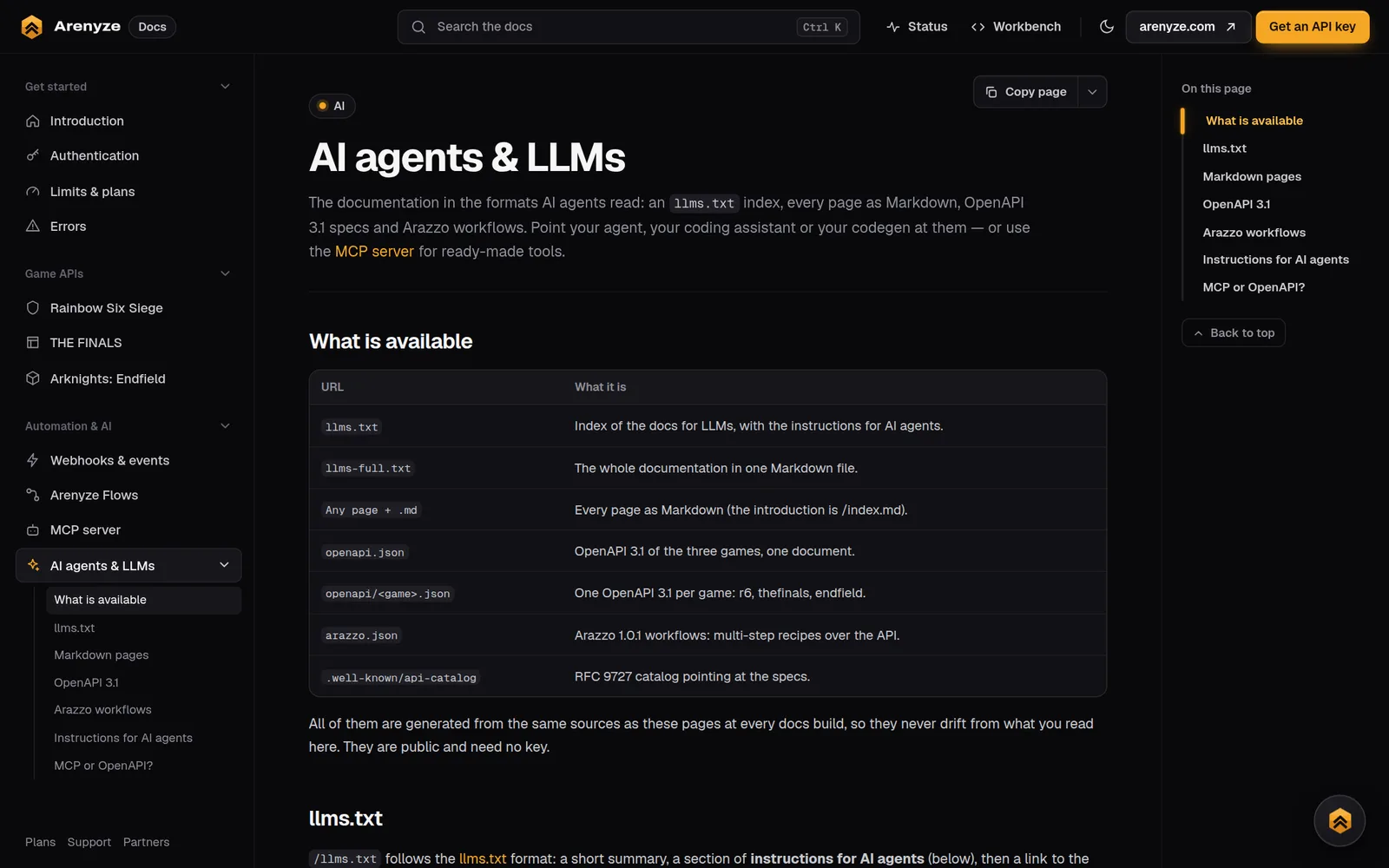
If you build with AI tools, the documentation is published in forms they can read directly:
llms.txtis a short index for language models, with explicit instructions for agents: how to encode names, which identifiers each game uses and how to back off.llms-full.txtis the whole documentation in one file.- Every docs page is also available as Markdown: add
.mdto the URL, or sendAccept: text/markdown. - OpenAPI 3.1 specs for all games or one game at a time, ready for code generators and API clients.
- Arazzo workflows that describe multi-step tasks, such as a full THE FINALS player report or an Endfield operator build, step by step.
- A hosted MCP server at
mcp.arenyze.comthat gives assistants such as Claude or ChatGPT the same data as ready-made tools, with OAuth sign-in or your API key.
A checklist before you go live
- The key is stored in an environment variable on a server, and never shipped to a browser or app.
- Player identifiers are stored in full: the Embark name with its tag, the R6 name with its platform, the Endfield UID.
- Names are URL-encoded before they go into a path.
- Responses are cached, with a lifetime that matches how often the data changes.
429waits forRetry-After,404is not retried, and5xxfalls back to the cache.- Changes you only need to react to come from webhooks or Flows, not from polling.
- You test failures in the Workbench sandbox with simulated errors before your users meet them.
Arenyze is not affiliated with or endorsed by Ubisoft, Embark Studios or Hypergryph / GRYPHLINE. Rainbow Six Siege, THE FINALS and Arknights: Endfield are trademarks of their respective owners.
The people who build and run the Arenyze network: the trackers for Rainbow Six Siege, THE FINALS, Arknights: Endfield and Delta Force, the developer API and the tools around them.